Below is the text of the conference paper I’m presenting at the annual conference for the Society for Cinema and Media Studies on March 26th.
***
Liberation Radio(s) Beyond the Internet Imaginary
A couple years into working on my book Other Networks: A Radical Technology Sourcebook, I noticed I couldn’t stop marveling at the flexibility of radio: the incredibly wide range of wireless networks created by artists and activists as much as engineers; and how most of these networks have been forgotten or mistakenly consigned to the so-called dustbin of history. I started to say to whoever would listen, “Radio is the future!” Even while learning the parallel history of authoritarian regimes’ and counter-revolutionary forces’ use of radio, my belief that radio could be a future beyond our current internet has only intensified the more I learn about clandestine radio, pirate radio, and microbroadcasting interventions that have taken place since the 1930s around the world–whether in the Americas, Europe, Africa, or Asia–and about how all of these interventions have revolved around collective learning, building, listening, and transmitting as part of a movement to overthrow oppressive forces. And the word ‘collective’ here is not just a nice qualifier – collectivity is actual central to all of these actions.
I should not, then, have been surprised when my aphorism suddenly transformed from “radio is the future” to “radio is back” with the onslaught of yet another gruesome war. About a month ago, 12 hours after the U.S. and Israel commenced airstrikes against Iran on February 28th, amateur radio enthusiasts logged the appearance of a clandestine numbers radio station they called V32. This is the first unlicensed, politically motivated radio broadcast station to appear since 2010. Apparently still coming on the airwaves twice a day at set times but on different frequencies, V32 seems to serve only one purpose: to broadcast over shortwave radio the recitation of numbers in Farsi (“V32” and Manchester). The numbers likely correspond to a message that has been encrypted using what’s called a “one-time pad” whereby a random sequence of numbers is printed on a sheet of paper along with corresponding letters of the alphabet; only someone with an identical copy of the pad can decode the message after which the pad is destroyed (Lugrin et al). It’s an elegantly simple, extremely inexpensive, highly effective encryption technique, especially when compared with digital and online encryption techniques that are complex, costly, and never risk-free.
The seemingly unassailable hegemony of the contemporary internet means too few people know that shortwave radio has never gone away and that in many ways it’s more durable, more secure, and more widely accessible than other contemporary forms of wireless communication such as cell or wifi. Shortwave radio signals can travel almost at the speed of light over thousands of miles across national borders and well into remote areas not accessible by any other means of telecommunication. Radio waves can also propagate without wires which not only means their infrastructural requirements are far less than conventional forms of telecommunication that transmit sound waves through wires and cables. But it also means that means clandestine radio broadcasts are notoriously difficult to trace. Once the Iranian government started aggressively jamming the signal starting on March 4th, retired intelligence officers and amateurs started to speculate that the signal might actually be American or Israeli in origin, likely intended as a scare tactic directed at the Iranian government rather than an attempt to communicate with agents. As far as I know, none of these ex-intelligence officers or amateurs are aware of the clandestine radio station Free Voice of Iran that existed in 1980 and which was used by newspapers in the U.S. to report on opposition to and corruption in the government of Ayatollah Khomeini, until they eventually discovered that the CIA was behind the broadcasts (Soley et al 2).
It’s hard to resist the allure of a story about a mysterious Cold War tactic that suddenly re-emerges in 2026. But more importantly, this story is a reminder that while a long lineage of philosophers, theorists, and historians of technology have investigated the extent to which “artifacts have politics” (as Langdon Winner put it in 1980), radio still remains unruly, never quite fitting into any of these theories about technology. More specifically, understood together, V32, launched just last month, and the Voice of Free Algeria, launched in 1956 and which I will talk about today, show us that radio is probably best understood not such much as a technology as a wide range of techniques for harnessing the capabilities of the electromagnetic spectrum. It’s probably much more accurate to say that radio shows us “techniques have politics.” And since techniques are expressions of culture, they can be used just as easily by insurgents as by counter-insurgents.
I have not yet come across any attempts to frame the work of political philosopher and psychiatrist Frantz Fanon as media theory; but I have found Fanon’s account of the Voice of Free Algeria in his 1959 A Dying Colonialism revelatory in terms of how he never refers to French colonial radio or native Algerian radio as a technology. Instead, over and over again, he discusses it in terms of techniques, yes, but techniques that are always preceded by a particular consciousness–either a colonialist consciousness “defined and measured in European terms,” also as exemplified by V32, or a consciousness working toward the complete and total overthrow of the larger “racist, colonialist system that [could] open the way to imagine a whole new world” (Kelley 10).
According to Fanon, prior to the end of World War II, radio in colonized Algeria was an instrument mostly used to reassure Europeans that coloniality would continue indefinitely–“a technique in the hands of the occupier which, within the framework of colonial domination, corresponds to no vital need insofar as the ‘native’ is concerned” (3). Thus, colonized Algerians, as he put it, simply “refused this technique.” But then, with the “wholesale introduction of radio sets in Algeria [which] coincided with the setting up of national broadcasting stations in Syria, Egypt, and Lebanon” (3) along with the introduction of the small and relatively inexpensive transistor radio in 1947, a shift in attitudes or an inner or radical “mutation,” (8) as he put it, slowly took place in the minds of Algerians as they started to see radio a potential technique of mass struggle. More recently documented by investigative journalist Ana Rodriguez, in 1951, after a few farmers reportedly tuned into to radio broadcasts coming from outside of Algeria about anti-colonial uprisings in Tunisia and Morocco, word started to spread and suddenly, what had seemed impossible–in this case, life beyond oppression under colonial rule–started to seem possible. But it wasn’t until 1954 that Algerians warmed to the idea of owning their own radio sets. On November 1, 1954, the Voice of the Arabs from Cairo announced the start of Algeria’s war of independence: “Today, Algeria has begun a fight for freedom and Islam! Today…Algeria has begun to live a dignified life. Today, a powerful elite of free Algerian boys has unleashed the insurrection of Algerian freedom against tyrannical French Imperialism in North Africa” (quoted in Rodríguez).
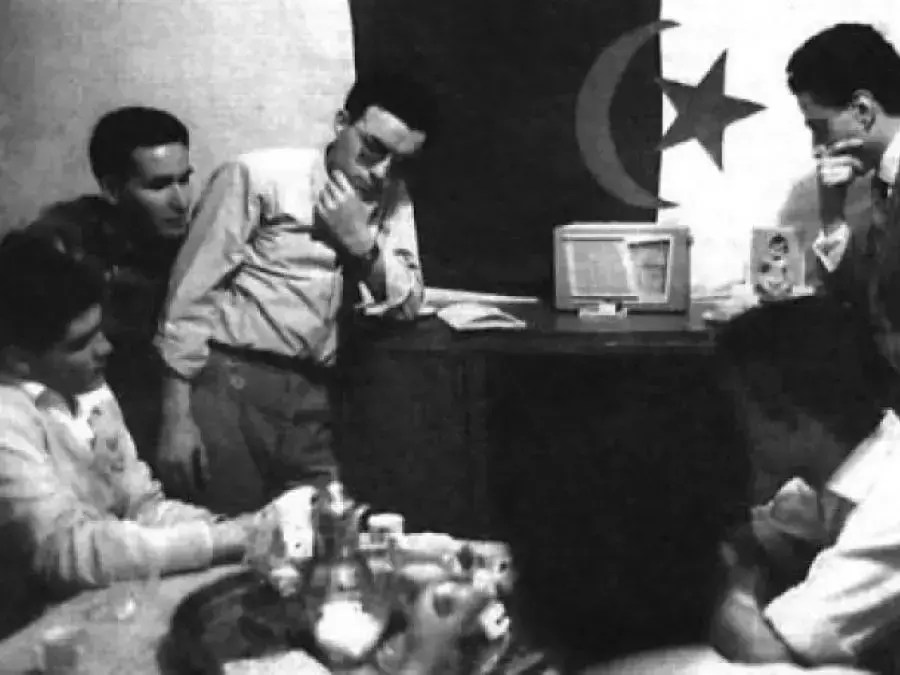
However, while Voice of the Arabs in Cairo (along with Radio Tunis and Radio Damascus) publicized and supported the Algerian revolution, these broadcasts were not reaching Algerians themselves (Benammar 15). Also bearing in mind relatively low literacy rates among Algerian workers at this time, establishing a clandestine radio station from within Algeria was the next logical option. A year later in 1955, “Europeans, and even Algerians, could be heard to refer confidentially…to a technique of long-distance communication that vaguely recalled some such system of signaling, like the tom-tom, as is found in certain regions of Africa. The Algerian gave the isolated European the impression of being in permanent contact with the revolutionary high command. He showed a kind of amplified self-assurance which assumed rather extraordinary forms. There were cases of real ‘running amuck.'” (5) Then, on December 16, 1956, on the orders of the late Majahid Abdelhafid Boussouf, listeners would have heard these words spoken in Arabic in the first broadcast, transmitted from a mobile radio station that moved throughout the mountains and border regions: “Here is the radio of free and fighting Algeria…the voice of the National Liberation Army and the National Liberation Front speaks to you from the heart of Algeria” (“Clandestine Radio”).
The new-found ability to imagine otherwise–“the challenging of the very principle of foreign domination [brought] about essential mutations in the consciousness of the colonized, in the manner in which he perceives the colonizer, in his human status in the world.” (10) And it was this new-found ability that also led more and more Algerians to acquire their own radio sets and collectively listen to the announcement of the existence of a Voice of Free Algeria that materialized as if out of nowhere in 1956. Further driven by the emergence of portable battery sets in areas that lacked access to electricity, “the technical instrument of the radio receiver lost its identity as an enemy object” or, as he puts it elsewhere, “a foreign technique.” (11) Even when French colonizers jammed the signal of the Voice of Algeria and even when they prohibited the sale of radios and battery sets, the mere existence of this clandestine radio station, no matter how “phantom-like,” only served to bring into being “the first words of the nation.” (13) Algerians began imagining themselves and their world as radically otherwise in the wake of radio broadcasts of liberation movements elsewhere. They even imagined themselves as broadcasting and transmitting this new possible way of being to others around them, simply by using their voices as a way to pass on “the voice of the revolution” (15) or, in other translations, “the voice of the Fatherland.” (87) A shift in consciousness produced a radio technique that then shifted consciousness once more.
I think that, rather than approaching this clandestine radio station simply in terms of it being an example of anti-colonial or anti-capitalist activism or in terms of already existing theories of technology, Fanon’s approach to radio (which is also obviously part of a larger undercurrent of thought in Black radical writing) could be brought forward in any media studies attempt to account for and think beyond contemporary technology. First, as I stated at the beginning of my presentation, radio is not so much a technology as a set of techniques for harnessing the properties of the electromagnetic spectrum. Or, more precisely, after reading Fanon’s account, we should say that particular worldviews produce techniques which, in turn, produce artifacts such as handheld transistor radios, transceivers, and so on. And second, thinking of radio as a set of techniques that reflect a worldview releases us from a line of thinking that perhaps too easily get mired in debates about technological determinism, or that too easily falls into the western philosophical trap of theorizing about technological objects in the abstract while ignoring, underplaying, or treating as separate actual, materially-grounded, culturally-specific practices.
In painfully broad strokes, I do want to acknowledge that yes, of course, there are philosophers such as Heidegger who, right around the same time as Fanon was recording his experiences in Algeria, explored the notion of how technē (rather than technology per se or yet more theories about technology) might provide us with a way forward beyond western metaphysics. For Heidegger, we should attend to technē as a kind of artistic rather than instrumental know-how that can help reveal the essence of technology. By 1970, we also have pieces such as Hans Magnus Enzensberger’s “Constituents of a Theory of the Media” in which he discusses radio as an example of an “electronic technique” (15) that, at that moment in time, was used to consciously prevent the ruled class from seeing that it too had the ability to manipulate media. Likewise, in 1987, Vilém Flusser writes in Does Writing Have a Future? that “the function of codes” (which for him is something like content or messages) “does not depend on the metaphysical eidos of the medium but on the way the medium is used” (quoted in Marchessault 5). Not surprisingly, given the popularity of Flusser in German media circles throughout the 1970s and 1980s, media archaeology emerges in Germany in the mid-1990s not only with declarations about the importance of hands-on doing, making, and practice to understanding media technologies but also with assertions about how active experimentation with media technologies from the past allows us to imagine otherwise for the future.
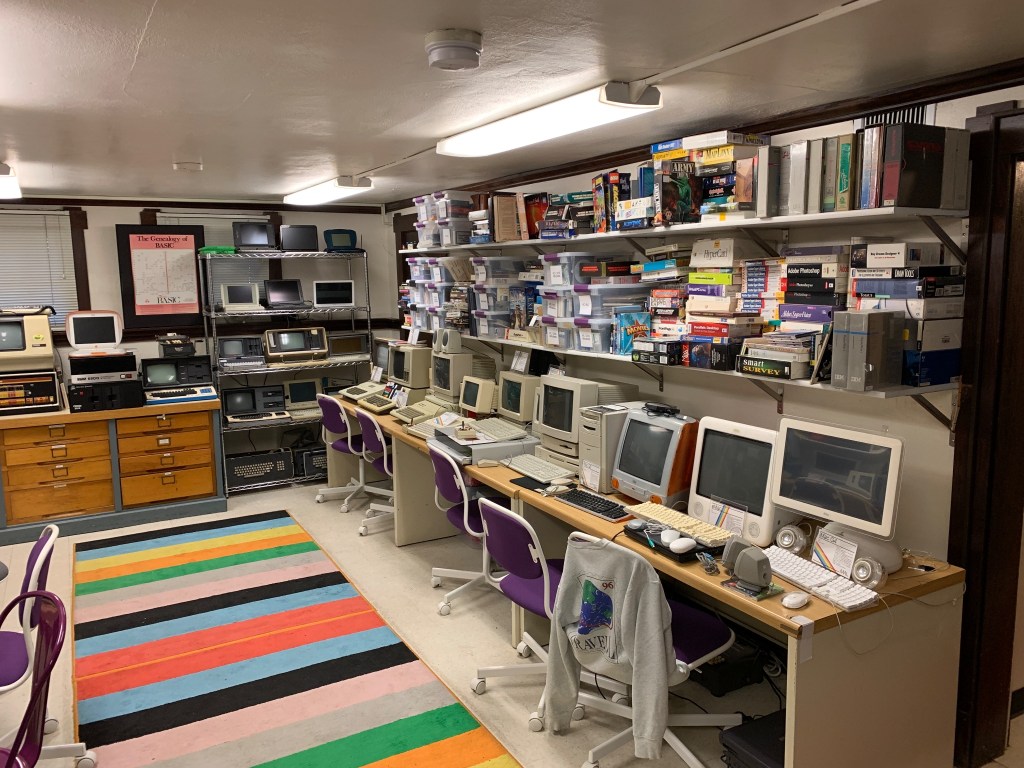
I myself have been very enthusiastic about using media archaeology to dig up technologies from the past to help us reimagine what’s possible in the future. But now that my lab, the Media Archaeology Lab, is full, from floor to ceiling, of well known and obscure technologies from the past, most of which work but also most of which no single person in the lab knows how to operate and nearly all of which has no manual or documentation describing how, for example, a stencil duplicator from 1940 works (because who, in 1940, would have thought that someone in 2026 would want to try to use one), I have started to think that we, collectively, don’t need any more technology. What we need is a shift in consciousness, a shift in our thinking, that’s paired with collectively shared and collectively taught techniques for using technology from the past for the future. Which brings me back to my aphorism about how radio is the future–or at least radio could be a future beyond the current internet.
While Heidegger, Enzensberger, Flusser, and certain thinkers in media archaeology such as Siegfried Zielinski and Erkki Huhtamo recognize the importance of techniques and/or practice as a way to understand and even manipulate technologies, they are all notably silent either about politics or about the politics of the future itself, and all are notably silent about the way that capital accumulation continues to work through the extraction of value from all people but particularly from BIPOC communities. Even while the theorists I just mentioned usefully and provocatively turn our attention away from technology and toward technique, without an understanding of interlocking oppressions that always, inevitably, intersect with technology, how do we imagine otherwise? Even modern-day Marxists can’t seem to see their way through to an alternative; Mark Fisher famously asserted that “It’s easier to imagine the end of the world than the end of capitalism” (8-9) while Franco ‘Bifo’ Berardi suggests we act ‘as if’.
As if the forces of labour and knowledge may overcome the forces of greed and of proprietary obsession. As if the cognitive workers may overcome the fractalisation of their life and intelligence, and give birth to a process of the self-organisation of collective knowledge… I cannot know what will happen after the future, and I must preserve the consciousness and sensibility of social solidarity, of human empathy, of gratuitous activity, of freedom, equality and fraternity. Just in case, right? Just because we don’t know what is going to happen next, in the empty space that comes after the future of modernity. (127-128)
Imagine an alternative future, and then act as if it is possible. But, despite Berardi’s passionate and persuasive discourse on acting ‘as if,’ as Ruha Benjamin points out in her recent Imagination: A Manifesto, “imagination” is hardly neutral territory. Whose imagination are we living in right now? What exactly does it look like to preserve the “consciousness and sensibility of social solidarity”, especially while existing in systems, institutions, ways of being and thinking that produced today’s interlocking oppressions in the first place? My answer is the same answer that Black radical, decolonial, and feminist thinkers have been giving us for well over a century. And while these approaches are rarely viewed as giving us theories to understand media, Fanon’s account of shifting techniques in and around radio lays out very clearly for us the ways in which 1) the experience of collective engagement with voices proclaiming the possibility of another way of being 2) can produce a shift in imagination, a change in consciousness, which 3) makes possible the transformation of a tool like radio from being the oppressor’s medium to a tool that, with the right techniques, can make what was seemingly impossible suddenly possible. Indeed, as James Baldwin writes, “Imagination creates the situation, and then, the situation creates the imagination. It may, of course, be the other way around: Columbus was discovered by what he found” (quoted in Benjamin 46). The situation imagination creates could be a numbers station run by the US or Israeli government or it could be the creation of the Voice of Free Algeria that played a pivotal role in the liberation of Algeria. Or the countless other examples of clandestine, insurgent, and, ultimately, liberation radio that have existed across the world since the 1950s and that still exist today. It is a matter both of whose imagination creates these techniques and, thus, what these techniques make possible.
Sources
Benammar, Saida Kheira. “Mass Media in Algeria.” Routledge Handbook on Arab Media (London: Routledge, 2020).
Benjamin, Ruha. Imagination: A Manifesto (New York: Norton, 2025).
Berardi, Franco ‘Bifo.’ “Precariousness, Catastrophe and Challenging the Blackmail of the Imagination,” Affinities: A Journal of Radical Theory, Culture, and Action 4:2 (Fall 2010).
“Clandestine Radio: The Voice of the Revolution That Triumphed Over Colonial Propaganda.” Algerian Radio (17 December 2025).
Enzensberger, Hans Magnus. “Constituents of a Theory of the Media.” New Left Review 64 (Nov/Dec 1970): 13-36.
Fanon, Frantz. “This is the Voice of Algeria.” from A Dying Colonialism. Trans. Haakon Chevalier (1965).
Fisher, Mark. Capitalist Realism: Is There No Alternative? (Winchester, UK: O Books, 2009).
Flusser, Vilém. Does Writing Have a Future? (Minneapolis, MN: University of Minnesota Press, 2011).
Heidegger, Martin. “The Question Concerning Technology.” The Question Concerning Technology and Other Essays (New York: Harper Perennial Classics, 2013).
Kelley, Robin D. G. “An Anticolonialist Poetics.” Discourse on Colonialism, by Aimée Césaire (New York: Monthly Review Press, 2001).
Lugrin, Thomas et al. “One-Time Pad,” Trends in Data Protection and Encryption Technologies (Springer Nature Switzerland): 3–6.
Manchester, Ringway. “Is Iran’s Mystery Numbers Station Being Targetted?” youtube.com. Accessed 24 March 2026.
Marchessault, Janine and Rainer Guldin. “Introduction.” Flusser Studies 6 (May 2008).
Rodríguez, Ana. “The Role of Clandestine Radio Stations in Algeria’s Independence.” Atalayar (15 August 2020).
Soley, Lawrence C. and John Spicer Nichols. Clandestine Radio Broadcasting: A Study of Revolutionary and Counterrevolutionary Electronic Communication (New York: Praeger, 1987).
“V32.” Priyom.org. Accessed 24 March 2026.
Winner, Langdon. “Do Artifacts Have Politics?” Daedelus 109:1 (Winter 1980): 121-136.
 loriemerson